


Teachers face a constant battle for attention. Between smartphones, social distractions, and the natural drift of a student’s focus, keeping a classroom engaged is harder than ever. Traditional lectures and paper quizzes often fail to spark the necessary excitement for deep learning. This is where gamification enters the picture, and one platform, in particular, has emerged as a frontrunner in this educational shift.
Quizizz has transformed from a simple quiz tool into a comprehensive learning platform that is reshaping how students interact with information and how teachers assess progress. By blending game mechanics with rigorous assessment tools, it is bridging the gap between entertainment and education.
This article explores how Quizizz is modernizing the classroom, supporting educators, and ultimately, changing the way students learn.
The Shift from Passive to Active Learning
The traditional classroom model often relies on passive learning. Students sit, listen, and occasionally take notes. Assessments are usually high-stakes events that induce anxiety rather than curiosity. Quizizz flips this dynamic by turning assessment into an active, low-stakes, and highly engaging activity.
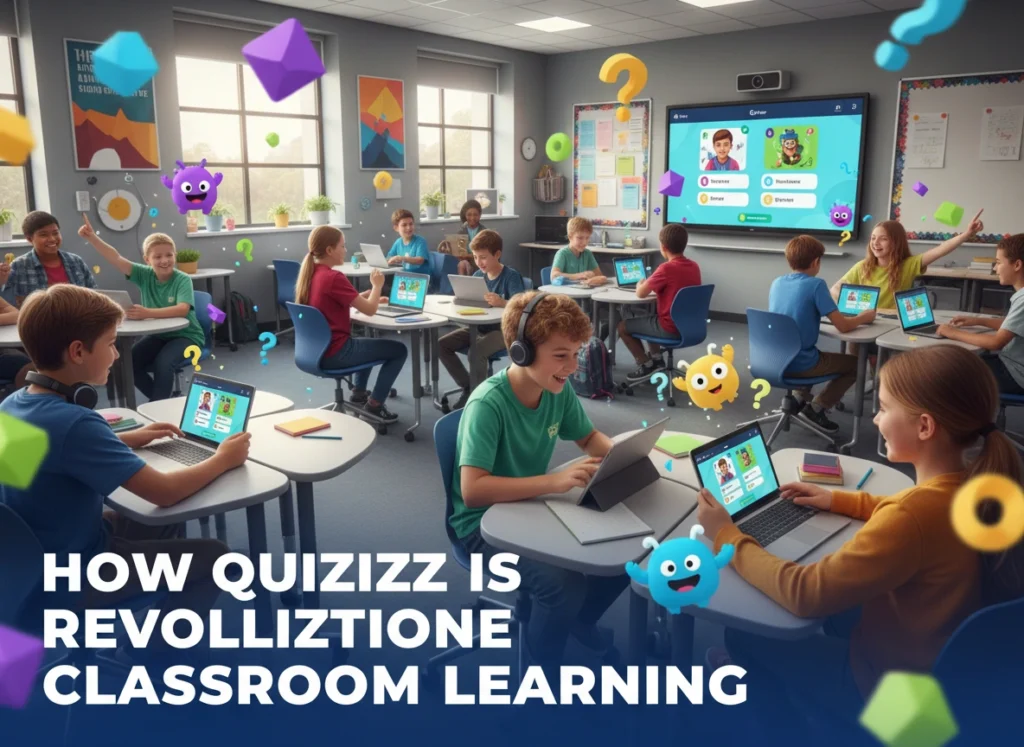
When a teacher launches a Quizizz session, the atmosphere in the room changes. Students aren’t just answering questions; they are competing, collaborating, and receiving instant feedback. This immediate loop is crucial. In a paper test, a student might not know they misunderstood a concept until days later when the graded paper is returned. With Quizizz, they know instantly if they were right or wrong, allowing for immediate correction and reinforcement.
The Power of Gamification
Gamification is not just about adding points and leaderboards; it’s about leveraging the psychological triggers that make games compelling. Quizizz utilizes several key features to do this:
- Avatars and Themes: Students can choose fun avatars and themes, giving them a sense of ownership and personalization within the learning environment.
- Power-ups: Unique to Quizizz, power-ups like “Immunity” (which allows a second try at a question) or “50/50” (which removes two wrong answers) add a layer of strategy. Students aren’t just recalling facts; they are managing resources and thinking critically about when to use their advantages.
- Leaderboards: While competitive, the leaderboard in Quizizz can be toggled to show only top players or be hidden entirely to reduce anxiety. When used effectively, it drives a healthy sense of competition that motivates students to pay closer attention.
Supporting Teachers with Data and Efficiency
While student engagement is the visible benefit, the backend value for teachers is perhaps even more significant. Grading is one of the most time-consuming tasks for educators, often eating into time that could be spent on lesson planning or student support. Quizizz automates this process entirely.
Instant Analytics and Insights
As soon as a quiz ends, teachers have access to a detailed dashboard. They don’t just see who won; they see granular data that informs instruction.
- Question-Level Analysis: Teachers can instantly see which questions were missed by the majority of the class. If 80% of students missed question #5, the teacher knows immediately that the specific concept needs reteaching before moving on.
- Student-Level Reports: Teachers can drill down into individual student performance to identify who is struggling and specifically where their knowledge gaps lie.
- Long-term Tracking: Over time, these reports help track progress, making it easier to generate data for parent-teacher conferences or administrative reporting.
Integration with Existing Workflows
A major barrier to adopting new ed-tech tools is the learning curve and integration with current systems. Quizizz has addressed this by integrating seamlessly with Learning Management Systems (LMS) like Google Classroom, Canvas, and Schoology. Teachers can assign quizzes directly within these platforms, and grades are automatically synced to their grade books. This interoperability ensures that Quizizz enhances the workflow rather than complicating it.
Beyond the Multiple-Choice Quiz
Early versions of gamified learning platforms were often criticized for being limited to simple multiple-choice questions. This format is great for fact recall but less effective for higher-order thinking. Quizizz has evolved significantly in this regard.
The platform now supports a variety of question types that encourage deeper cognitive processing:
- Open-Ended Questions: These allow students to type out answers, encouraging them to formulate their own thoughts rather than just recognizing the correct option.
- Polls: Useful for pulse-checks and gathering opinions, polls help teachers gauge student sentiment or start discussions without a “right” or “wrong” answer.
- Draw Questions: Particularly useful in STEM subjects, students can draw diagrams, solve math problems on screen, or annotate images to show their understanding.
- Audio and Video Responses: These features support language learning and oral assessments, allowing students to record their answers.
This variety means Quizizz is no longer just a review tool. It can be used for initial instruction, formative assessment, exit tickets, and even homework assignments that students actually want to do.
Addressing the “Speed vs. Accuracy” Dilemma
A common criticism of gamified learning is that it prioritizes speed over accuracy. In many platforms, the student with the fastest fingers wins, regardless of whether they truly understand the material better than their peers.
Quizizz tackles this with its “Student-Paced” mode. Unlike live games where everyone answers the same question at the same time, student-paced mode allows learners to move through the questions at their own speed. The questions appear on their own device, not a central screen.
This is a game-changer for inclusivity. It removes the pressure of the ticking clock that paralyzes some students. A student who needs an extra thirty seconds to process a math problem isn’t penalized or left behind. They can take the time they need, ensuring that the data the teacher receives reflects actual understanding, not just reaction time.
Asynchronous Learning and Homework
The revolution extends beyond the classroom walls. Assigning homework has traditionally been a struggle; completion rates are often low, and students rarely get feedback until the next day.
Quizizz allows teachers to assign quizzes as homework with a deadline. Students can complete these assignments on their phones, tablets, or computers at home. Because the interface is engaging and game-like, resistance to homework decreases. Furthermore, the “redemption question” feature allows students to re-attempt questions they got wrong at the end of the quiz, reinforcing learning through repetition and immediate correction.
Challenges and Considerations
Despite its success, integrating Quizizz is not without challenges. The “digital divide” remains a concern in education. While Quizizz works on smartphones, not every student has reliable internet access or a device at home. Schools must ensure that relying on digital platforms doesn’t disadvantage students from lower-income backgrounds.
Additionally, there is the risk of “gamification fatigue.” If used every single day for every single lesson, the novelty wears off. The tool is most effective when used strategically—as a hook at the start of a lesson, a check for understanding in the middle, or a review at the end—rather than as a replacement for all instruction.
Teachers also need to be mindful of the content. While there is a vast public library of millions of quizzes created by other teachers, quality varies. Educators must vet public quizzes for accuracy and alignment with their specific curriculum standards before assigning them.
The Future of EdTech and Quizizz
As Artificial Intelligence continues to permeate education, Quizizz is already adapting. New AI-driven features assist teachers in generating questions from reading passages or YouTube videos in seconds. This drastically reduces prep time, allowing teachers to create high-quality, relevant assessments on the fly.
The platform is also moving toward more adaptive learning paths. In the future, we can expect the system to automatically adjust the difficulty of questions based on a student’s real-time performance, providing a truly personalized learning experience without manual intervention from the teacher.
Conclusion
Quizizz is doing more than just digitalizing the pop quiz. It is fundamentally altering the classroom dynamic by making learning visible, interactive, and, dare we say, fun. By reducing the anxiety associated with testing and providing teachers with actionable data, it supports a more empathetic and effective learning environment.
The platform proves that rigor and engagement are not mutually exclusive. When students are motivated to participate, and teachers are equipped with the insights to guide them, the classroom becomes a place of active discovery rather than passive reception. As education continues to modernize, tools that prioritize both the student experience and the teacher’s workflow will lead the way, and currently, Quizizz is at the front of the pack.
Please click here for more info