

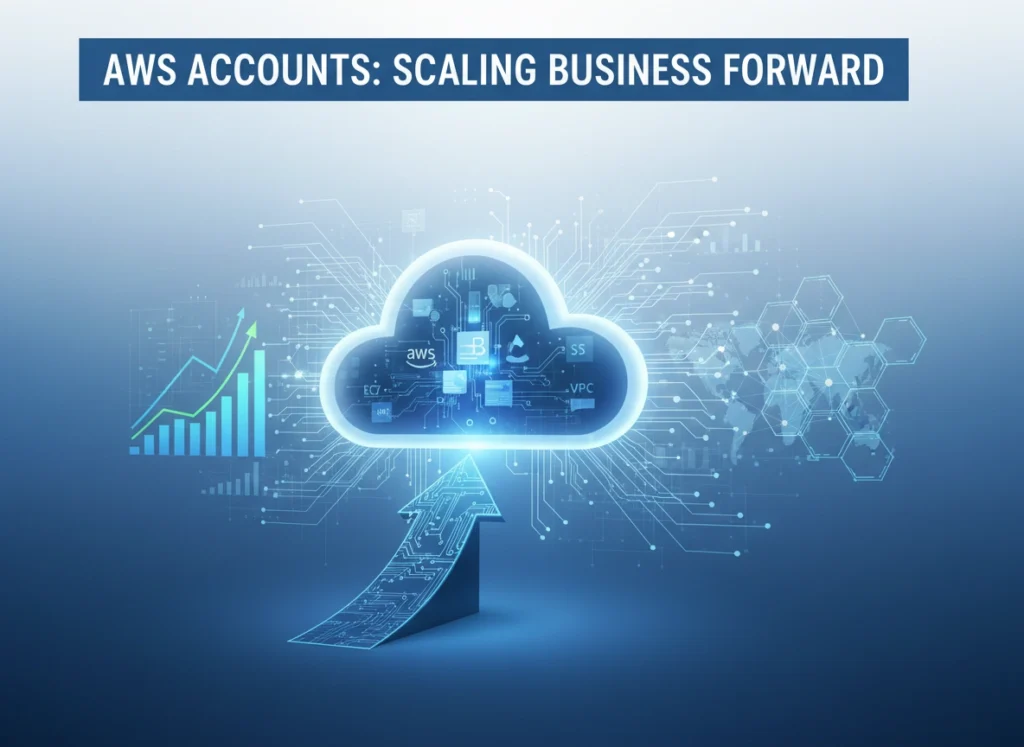

Amazon Web Services (AWS) has fundamentally changed how businesses operate and grow. By providing on-demand cloud computing platforms, AWS offers a flexible, reliable, and cost-effective alternative to traditional on-premise infrastructure. For any organization looking to expand, understanding the strategic role of an AWS account is not just beneficial—it is essential. An AWS account is more than a simple login; it is the gateway to a powerful suite of tools designed to support and accelerate growth at every stage.
This article explores how leveraging AWS accounts can be a cornerstone of your scaling strategy. We will cover how AWS enables scalability, highlight key services that drive growth, and discuss best practices for managing your cloud environment effectively.
How AWS Accounts Enable Scalability
Scalability is the ability of a system to handle a growing amount of work by adding resources. AWS is built from the ground up to provide this capability, and your AWS account is the control center for accessing it.
Elasticity and On-Demand Resources
The core advantage of AWS is its elasticity. Instead of purchasing and managing physical servers, which involves significant upfront investment and long procurement times, an AWS account allows you to provision computing resources in minutes. This means you can scale up your infrastructure to meet sudden spikes in demand—like a viral marketing campaign or seasonal traffic—and scale back down when demand subsides. This pay-as-you-go model eliminates wasted resources and ensures you only pay for what you use, a critical factor for managing costs during growth.
Global Reach with Minimal Investment
Expanding into new geographic markets traditionally required building or leasing data centers in those regions, a costly and complex undertaking. AWS has a global network of data centers, known as Regions and Availability Zones. Through your AWS account, you can deploy applications and services closer to your international customers with just a few clicks. This reduces latency, improves user experience, and allows you to establish a global presence without the massive capital expenditure.
A Foundation for Agile Development
Scaling a business often requires rapid innovation and development cycles. AWS accounts provide the tools to create isolated environments for development, testing, and production. This separation, often managed through a multi-account strategy, prevents development activities from impacting your live customer-facing applications. It fosters an agile workflow where teams can experiment, build, and deploy new features quickly and safely, accelerating your time-to-market.
Key AWS Services That Support Business Growth
Your AWS account unlocks over 200 fully featured services. While the list is extensive, a few key services are particularly instrumental in supporting business growth and scalability.
Compute Services: The Engine of Your Operations
Compute services are the backbone of most applications running on AWS. They provide the processing power your business needs to run its software and services.
- Amazon EC2 (Elastic Compute Cloud): This service provides secure, resizable compute capacity in the cloud. EC2 instances are virtual servers that can be launched on demand. The ability to use Auto Scaling Groups with EC2 allows your application to automatically add or remove servers based on predefined conditions, ensuring high availability and performance.
- AWS Lambda: Lambda is a serverless compute service that runs your code in response to events and automatically manages the underlying compute resources. This is ideal for applications with variable traffic. You can build highly scalable services without worrying about provisioning or managing servers, and you only pay for the compute time you consume.
Storage Services: Secure and Scalable Data Management
As your business grows, so does your data. AWS offers a range of storage solutions designed to be durable, available, and scalable.
- Amazon S3 (Simple Storage Service): S3 is an object storage service offering industry-leading scalability, data availability, security, and performance. It is perfect for a wide range of use cases, from hosting static websites and storing backups to housing data for big data analytics. Its “infinite” storage capacity means you never have to worry about running out of space.
- Amazon RDS (Relational Database Service): Managing databases can be complex, especially at scale. RDS simplifies the setup, operation, and scaling of a relational database. It supports popular database engines like MySQL, PostgreSQL, and SQL Server. With features like automated patching, backups, and read replicas, RDS offloads administrative tasks, allowing your team to focus on building your application.
Networking Services: Connecting Your Resources
Robust networking is crucial for connecting your cloud resources to each other and to your users securely.
- Amazon VPC (Virtual Private Cloud): A VPC lets you provision a logically isolated section of the AWS Cloud where you can launch AWS resources in a virtual network that you define. You have complete control over your virtual networking environment, including selection of your own IP address range, creation of subnets, and configuration of route tables and network gateways.
Best Practices for Managing AWS Accounts
As you scale, the complexity of your AWS environment will increase. Adopting best practices for account management from the beginning is crucial for security, cost control, and operational efficiency.
Implement a Multi-Account Strategy
Relying on a single AWS account for all your workloads is risky and inefficient. A multi-account strategy, using AWS Organizations, allows you to create separate accounts for different purposes, such as:
- Security: A dedicated account for security logs and tooling.
- Infrastructure: A central account for shared networking resources.
- Workloads: Separate accounts for production, development, and testing environments.
- Billing: Isolating costs by department, project, or environment.
This structure provides a strong security boundary, simplifies billing and cost allocation, and allows teams to operate with greater autonomy.
Prioritize Security with IAM
AWS Identity and Access Management (IAM) is the cornerstone of AWS security. It allows you to manage access to AWS services and resources securely. Always follow the principle of least privilege: grant users, groups, and roles only the permissions they absolutely need to perform their tasks. Avoid using the root user for daily tasks; instead, create IAM users with specific permissions. Enable Multi-Factor Authentication (MFA) on all accounts, especially the root user, to add a critical layer of security.
Monitor Costs and Set Budgets
The pay-as-you-go model is a double-edged sword. While it offers flexibility, unmonitored usage can lead to unexpected costs. Use AWS Budgets to set custom cost and usage budgets that alert you when you exceed (or are forecasted to exceed) your thresholds. Leverage AWS Cost Explorer to visualize, understand, and manage your AWS costs and usage over time. Tagging your resources is another powerful practice that allows you to categorize costs by project, department, or environment, giving you granular visibility into your spending.
Real-World Scaling with AWS: A Case Study
Netflix is one of the most prominent examples of a company that has leveraged AWS to achieve massive scale. When Netflix transitioned from its DVD-by-mail service to a global streaming giant, it needed an infrastructure that could handle immense and unpredictable demand. Building its own data centers worldwide would have been prohibitively expensive and slow.
Instead, Netflix migrated its entire infrastructure to AWS. By using services like Amazon EC2, S3, and a host of others, Netflix was able to:
- Scale Dynamically: Handle millions of concurrent streams and massive spikes in viewership during popular show releases.
- Achieve Global Reach: Quickly deploy its service to over 190 countries by using AWS’s global infrastructure.
- Innovate Rapidly: Use the flexibility of the cloud to experiment with new features and analytics, continually improving its service.
The Netflix story demonstrates the transformative power of AWS. The platform provided the foundation for Netflix to grow from a niche service into a global entertainment powerhouse, a feat that would have been nearly impossible with traditional infrastructure.
Conclusion
An AWS account is far more than a simple entry point to cloud services; it is a strategic asset for scaling your business. By providing on-demand resources, global reach, and a vast ecosystem of powerful services, AWS empowers organizations to grow efficiently and securely. To harness this power, it is vital to adopt best practices in account management, focusing on a multi-account structure, robust security through IAM, and diligent cost monitoring. By doing so, you can build a resilient, scalable, and cost-effective foundation that will support your business as it reaches new heights.
Please visit the Official Website for more info.